July 30, 2026
Trained on AI Doesn't Mean Ready for AI
Why workforce capability decides whether every other part of an AI investment pays off, and what it takes to build it before deployment, not after.
You rolled out the system. You trained the team. On paper, this workforce is ready.
Then an operator gets an AI-generated maintenance recommendation. He reads it twice. He picks up the phone and calls his supervisor instead of acting on it.
That's not a training failure. It's what training alone can't finish. He doesn't trust what the system just told him to do, not yet. That kind of trust doesn't come from a rollout. It gets tested every time the system flags something new.
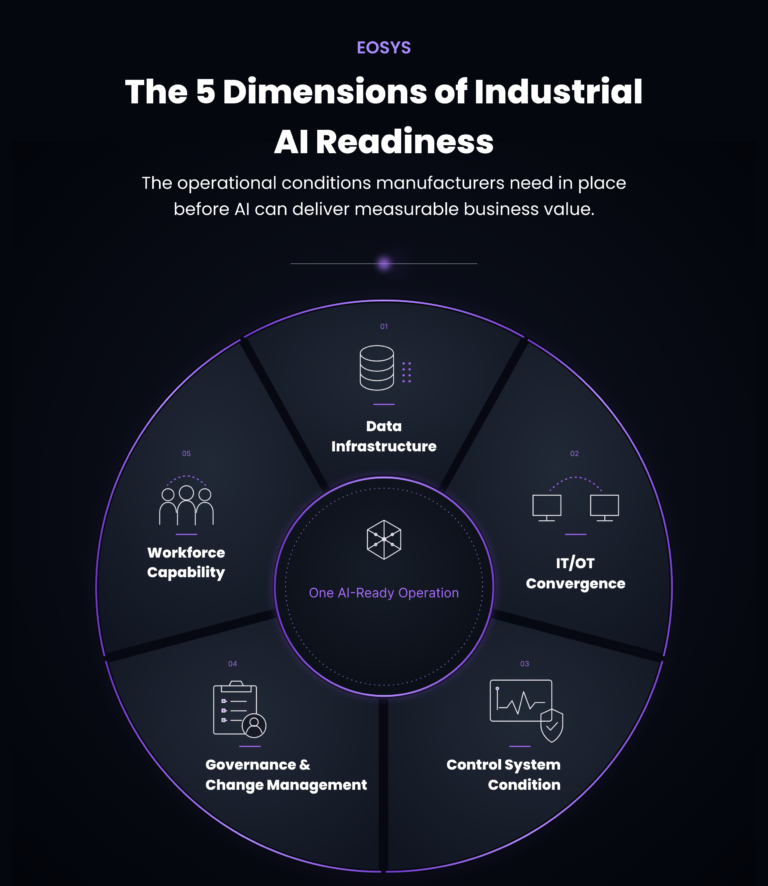
That test is one piece of a larger picture. AI readiness comes down to five dimensions, and this is the one still in question after the other four are settled.
The Five AI Readiness Dimensions
Resource: E-Guide | Am I Ready |
Every dimension except workforce capability is engineering and policy work. Specify them, build them, sign off on them.
A plant can get every other dimension right and still watch a deployment stall for entirely human reasons.
That operator on the phone isn't a training failure. He's what workforce capability actually looks like, standing at a workstation, deciding whether to trust what the plant just spent a year building.
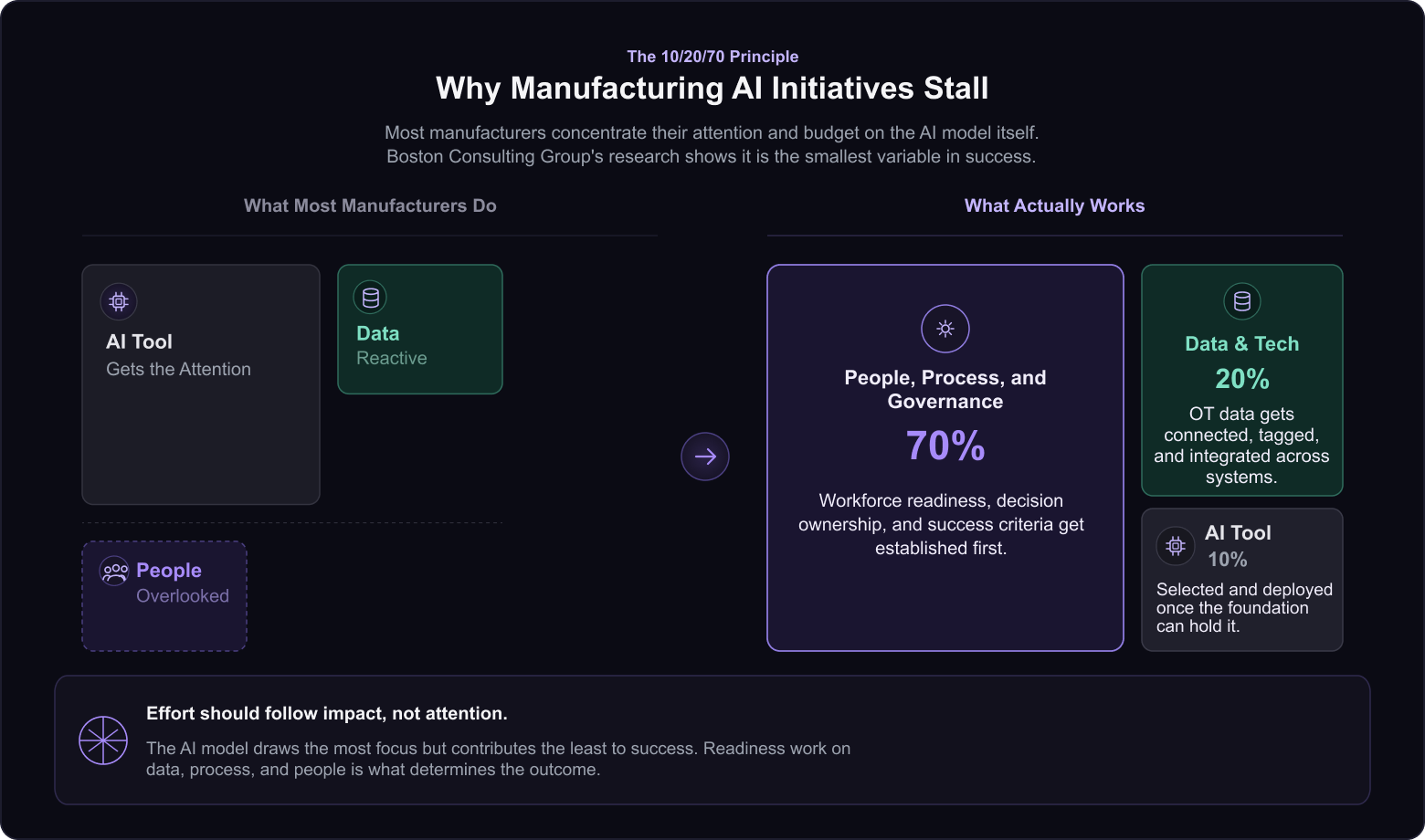
Research by the Boston Consulting Group on AI transformation explains why workforce capability doesn't follow the same path as the rest.
Only 10 percent of AI success traces to the algorithm itself, while 20 percent traces to data and technology. The remaining 70 percent comes down to people, process, and cultural change, which the exact ground workforce capability covers.
On the Plant Floor, AI Adoption Follows a Different Timeline
Workforce capability may be the most consequential dimension of AI readiness.
Every other dimension can be exactly right and still need workforce capability to deliver any return. It's also the hardest to verify without being there in person.
A data pipeline or a control panel can be checked against a spec sheet. There's no document that tells you whether an operator trusts what the system says.
A plant with clean data and a current control system still stalls if the people running it don't trust what the equipment tells them.
That trust problem is the same 70% that Boston Consulting points to, playing out on the production line.
A workforce that's been told about AI isn't the same as a workforce that's ready for it, and naming that difference honestly is the first step toward building readiness.
Many organizations skip past that harder conversation and default straight to a training session, treating awareness as if it were the finish line.
Skills and Ownership Are Two Different Challenges
The shortage of AI skills is one of manufacturing's biggest concerns, ahead of budget, ahead of the technology itself. A Deloitte survey of 600 manufacturing executives puts a number on it, and ranks human capital as the least mature category across all measured readiness dimensions.
Awareness of AI is not the same as being able to operate it, and few plants pin down the difference until a deployment forces them to do so.
Ownership is the second piece. Someone inside the organization needs to be named to manage, question, and improve the system over time. Without that person identified early, the knowledge and authority to run the system never fully settles inside the plant. The system keeps running. The confidence to steer it doesn't show up with it.
Operator Trust Has to Be Earned, Not Announced
Remember the operator on the phone, the one who paused instead of acting on the system's recommendation? His hesitation wasn't a resistance problem. It was a signal that nothing here had earned his confidence yet.
The real question isn't how to get him past it. It's what would need to be true before he trusts the next alert enough to act on it alone.
Plants that get this right will treat an operator’s hesitation as a signal to investigate, not a hurdle to push past.
AI Change Management on a Manufacturing Floor Should Look Concrete, Not Aspirational
Making this dimension real isn't abstract. It comes down to four things, decided now, not discovered later.
What Workforce Readiness Actually Requires
|
None of that shows up on a punch list the way a controller upgrade does. Workforce capability has to be handled the same way technical work is: assessed honestly, planned deliberately, and owned by a specific person.
The difference is that workforce capability doesn't stop at go-live. It keeps asking for attention after everything else has already had it.
A plant can get every other readiness dimension right and still watch a deployment stall for entirely human reasons. That's the operator from the beginning, still standing at his workstation, deciding whether to trust what the plant spent a year building.
A workforce capability assessment measures this dimension alongside the other four, not after. Knowing where you stand starts with the assessment.
Workforce Readiness, Answered Plainly
Whether the people running a plant can work effectively alongside an AI system once it's live, not just whether they've been introduced to it. It covers three things: closing specific industrial workforce skills gaps, naming a long-term internal owner, and building enough trust that operators act on what the system tells them.
Being informed means the team sat through training. Being ready means an operator acts on an AI-generated recommendation without first calling a supervisor. Most plants never test that difference until a deployment forces them to.
Someone inside the organization, named before go-live, not after something breaks. That person needs the standing and technical grounding to manage, question, and improve the system with confidence.
That's a signal to investigate, not a resistance problem to push past. An operator who hesitates usually has a specific reason, and understanding it is the fastest way to earn trust.
Directly. The Boston Consulting Group attributes 70% of AI success to people, process, and cultural change, not the AI model or the tech stack. A strong business case and a technically sound deployment can still stall if the people running it day to day never bought in.
Governance sets who owns AI decisions on paper: a policy, a process, a named sponsor. It gets revisited as regulations and use cases change, but there's always a document to check it against. Workforce capability doesn't work that way. There's no policy that tells you whether an operator trusts the system. That gets tested every time it flags something new.
Name the specific skills the deployment will require, test whether operators trust the kind of recommendations the system will generate, and identify who inside the plant will take ownership of it. Settle all three before go-live, not after the system is already running.