
August 6, 2026
Leadership Says Go. Governance Is What Holds a Manufacturing AI Pilot Together.
Executive sponsorship gets an AI initiative started. Governance is what gets it to production. Here is what that structure looks like, and why it has to be in place before a pilot begins.
The promise of AI looks different in a conference room than on a production floor. Leadership saw the vision and committed. Everyone left the meeting believing it was settled.
But if you were not in that room, the conversation you are having looks nothing like the one that just ended.

And somewhere between that room and the production floor, the plan stopped being a shared understanding and became two separate conversations. One about AI strategy, timelines, and deliverables. The other is more urgent. Who decides when the system and the operator disagree?
Both conversations are happening right now in most manufacturing organizations. But these are not the same conversation.
The gap between them is not a technology problem but a structural one. And it is the most common reason AI initiatives move from proof of concept to pilot, and then stay there.
Sponsorship Is Not a Structure
When AI manufacturing pilots stall, most organizations point to data quality, integration complexity, or scope creep. Those are factors. The research points deeper.
Change management researchers at Prosci measured AI trust across organizational levels. Neither group is a believer. Frontline workers barely trust it. Executives trust it more, but not by much. And the people authorizing deployment are still three times more confident than the people expected to operate alongside it.
Most organizations never built the structure to close that distance. That is where governance lives.
Deloitte's 2026 enterprise AI report found that only one in five organizations has a mature governance model for autonomous AI agents. Most are deploying anyway.
The pattern is consistent: executive vision exists, intent is clear, and the structure to carry it down to the plant floor is still missing.
What Governance Actually Means on the Plant Floor
Governance is the decision structure that determines who owns an AI initiative, how conflicts get resolved, and what success looks like before a pilot begins.
5 Things Your Governance Structure Must Have
Resource: E-Guide | Am I Ready |
That last condition is where the stakes are highest. When the AI model recommends a shutdown and the operator disagrees, what happens? There is rarely a written answer. The operator overrides and logs nothing, or defers without sufficient reason to. Either way, the organization has no record or defense.
Boston Consulting Group's research places 70% of AI success in people, processes, and organizational change, with just 10% in the algorithm itself. Without governance, organizations build the technology and wonder why execution and adoption stall.
Zach LaDouceur, Digital Transformation Sales Leader at EOSYS, has seen this gap play out directly.
"Usually, it boils down to a lot of things that are less related to technology and more related to business and stakeholder alignment. You've got to make sure you have the right stakeholder alignment from executive leadership down to frontline workers. If you don't maintain that alignment top to bottom, you're at risk of losing funding and sponsorship, or you won't get end-user adoption, and you won't scale."
- Zach LaDouceur
The Cost of Skipping Industrial AI Governance
The difference between manufacturers seeing returns from AI and those still waiting is not the technology they selected. It is whether anyone owns the outcome.
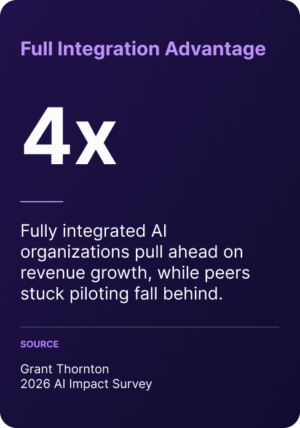
Organizations with fully integrated AI are nearly four times more likely to report revenue growth than those still piloting, 58% versus 15%, according to Grant Thornton's 2026 AI Impact Survey.
Governance is also becoming a legal question, not just an operational one. The EU AI Act is the world's first comprehensive AI law, and it is active.
It sets binding requirements for how AI systems are developed, documented, and overseen, with the strictest obligations falling on high-risk applications.
For manufacturers with EU operations or customers, the compliance clock is already running.
The U.S. picture is less settled but moving in the same direction. Federal agencies roughly doubled AI-related regulatory activity in 2024, and state-level pressure is building at the same time.
There is no single governing statute yet, but the trajectory is clear. Manufacturers who build governance now absorb that pressure from a position of preparation.
Organizations that skip governance do not avoid the accountability question. They answer it only after something goes wrong, not before a pilot begins.
Where Your Organization Stands
An AI readiness assessment measuring manufacturing organizations across five dimensions, data infrastructure, control system condition, IT/OT convergence, governance and change management, and workforce capability, gives operations leaders a clear picture of where they stand before a pilot begins.
The governance dimension covers decision ownership, executive alignment, plant-floor buy-in, success criteria, and conflict protocols.
Your score tells you which conditions are in place and which need attention before a pilot moves to a live production line. Ten minutes. Five dimensions.
The governance question is worth answering before a pilot starts. Building the structure first is faster than fixing it after one has stalled.
Questions Worth Asking About AI Governance in Manufacturing
AI governance in a manufacturing context is the decision structure that determines who owns AI initiatives, how conflicts between AI recommendations and operator judgment get resolved, and what success looks like before a deployment begins. It matters because most AI pilots that stall do not fail on technology. They stall because no one owns the call to scale, stop, or adjust. Governance is what makes that call possible.
Executive sponsorship is the commitment at the top: the leader or team driving the initiative, authorizing resources, and making AI a stated priority. Organizational readiness is the structure built below that commitment. A sponsor can be fully engaged while plant-floor leadership remains uninformed, success criteria undefined, and conflict protocols unwritten. Those conditions do not close on their own. Many manufacturers have strong sponsorship and are still missing the structure beneath it.
The most common reason is not technology. It is ownership. When no one has a named role in deciding whether to scale, stop, or adjust a pilot running on a live production line, the default is to keep running it indefinitely. Deloitte found that only one in five organizations has a mature governance model for autonomous AI agents. Most manufacturers running pilots today are in the other 80%.
Before a pilot moves to a live production line, five things need to be in place: a formal evaluation process, executive sponsorship that connects to the operating layer below it, plant-floor leadership that was consulted before scoping began, success criteria written before the first line runs, and a documented protocol for resolving AI-operator conflicts. Organizations that skip those steps do not avoid the problems. They just find them later, under worse conditions.
The US regulatory picture is still taking shape, but the direction is clear. Federal agencies roughly doubled AI-related regulatory activity in 2024, and state-level pressure is building. The trajectory points toward more oversight, not less. US manufacturers looking for a sense of where things are heading need only look at the EU AI Act, already active law in Europe. Manufacturers who build governance now are better positioned to absorb that pressure when it arrives.
AI success breaks down as 10% AI model, 20% data and technology, and 70% people, processes, and organizational change, according to research from Boston Consulting Group. Most organizations invest heavily in the first two and underinvest in the third. Governance is the structure that determines whether that 70% takes hold. Organizations that build the technology without building the decision structure around it get the algorithm. They do not get adoption.