August 13, 2026
The Order of Operations: Why Most Manufacturing AI Initiatives Fail Before They Start
A manufacturing AI deployment formula that shows where effort belongs, and the five readiness dimensions that determine whether it scales.
You may already be feeling it, even if you can't quite put your finger on it.
Leadership sees where the industry is heading. They see the competitive pressure building. They want an AI strategy, and they want it now.
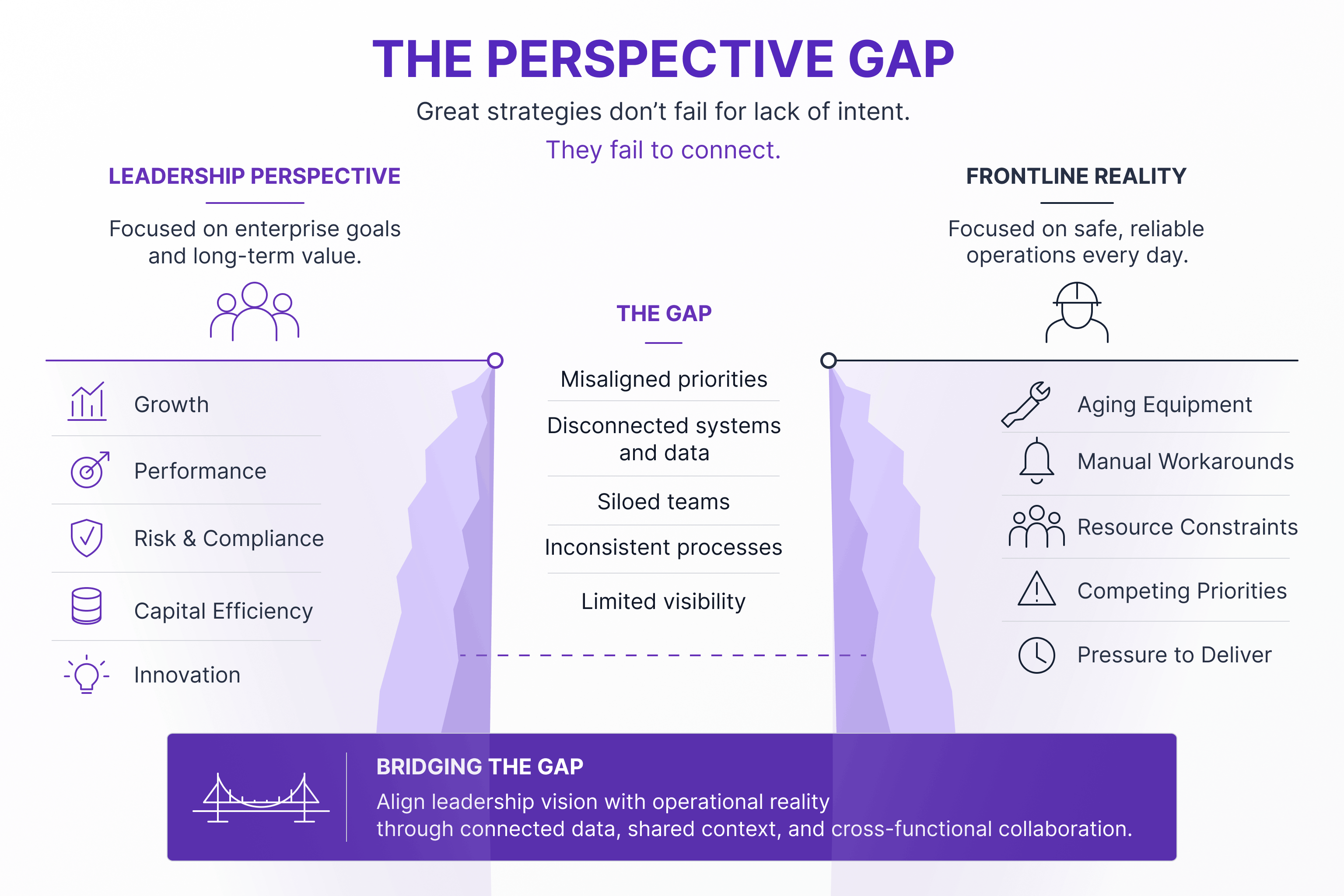
Meanwhile, the plant floor is running systems that were never designed to support what leadership is describing.
That distance between what leadership is asking for and what the operation can currently carry has a name.
We call it the perspective gap. And if you are the one fielding questions from both sides, you already know how wide it can be.
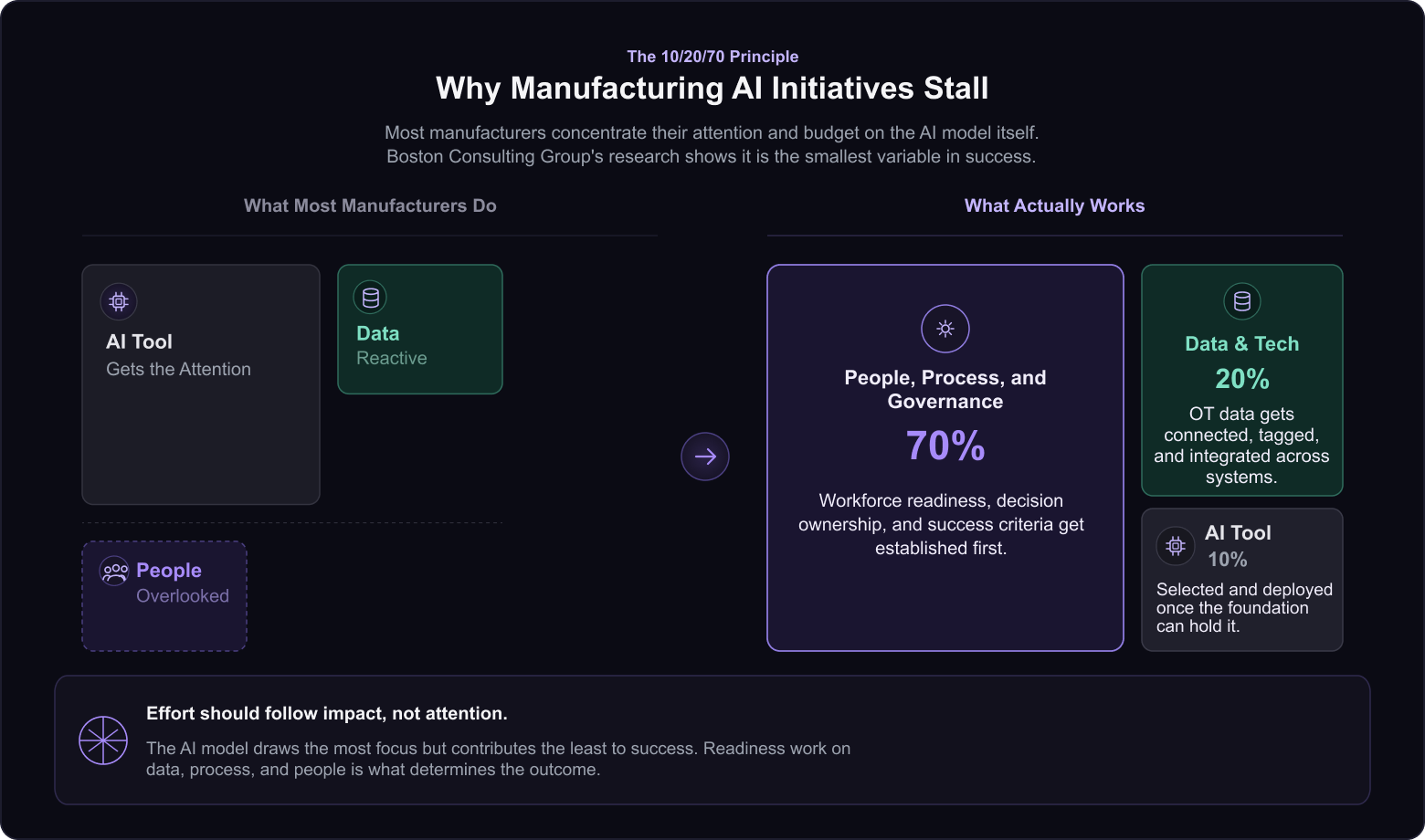
Getting there comes down to directing effort in the right places. Boston Consulting Group research into AI performance shows exactly where that effort falls.
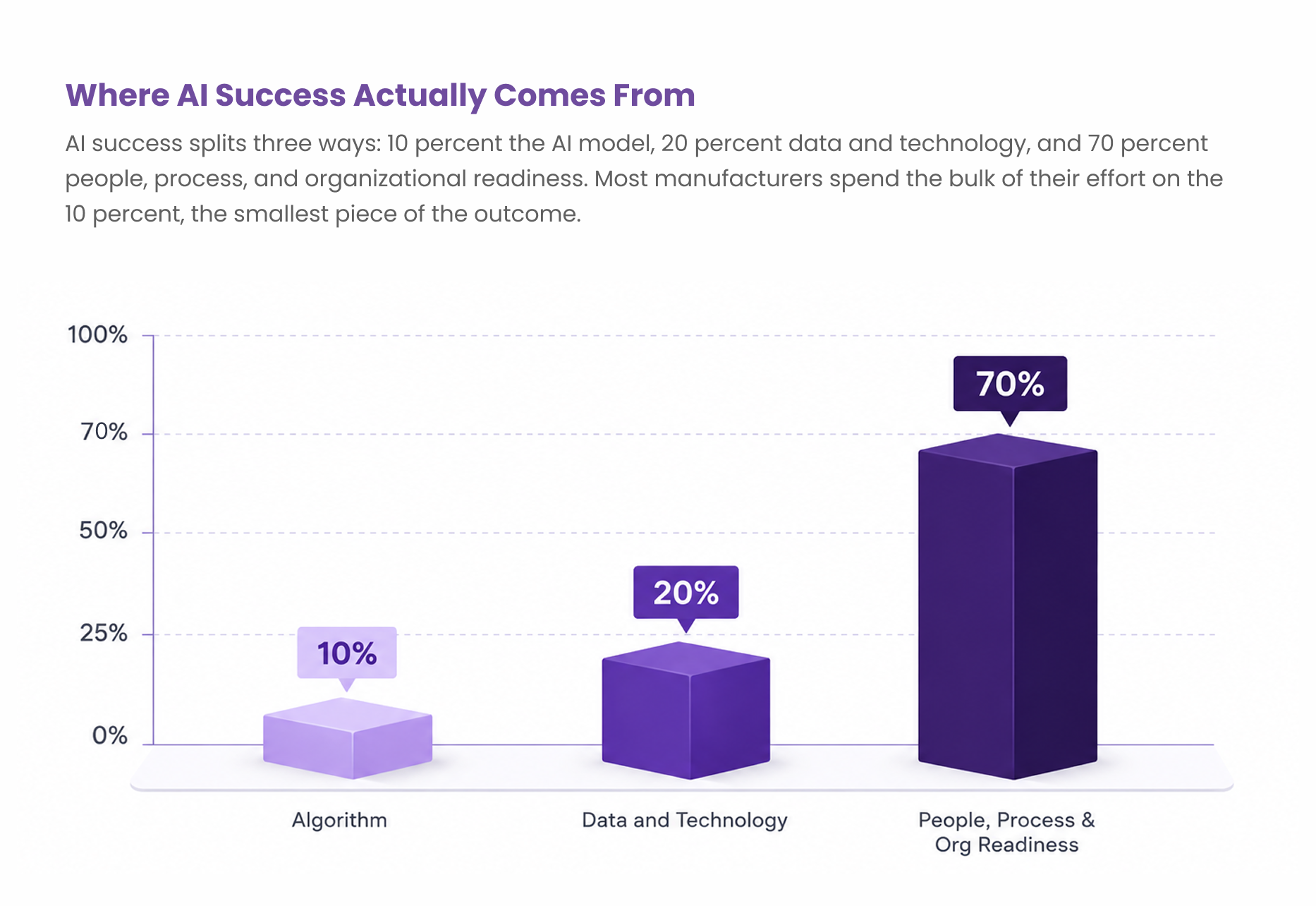
Most manufacturers invest in the 10% first. It wins the demo, drives the capital request, and ends up in the PowerPoint presentation. The other 90% determines whether it ever works on the floor.
Boston Consulting found that 74% of companies have yet to generate tangible value from their AI investments. When considering where most of the investment goes, that number is not surprising. The model gets the budget and the attention.
The data infrastructure, governance structures, and workforce preparation that determine whether the model ever delivers on the floor get what's left.
The ambition is there.
The investment is there.
It is going to the 10% before the 90% is ready to support it. That is the order most manufacturers follow. It is not the order that works.
You may already be feeling it, even if you can't quite name it. Leadership sees where the industry is heading and wants an AI strategy now. The plant floor is running systems that were never designed to support it.
That distance has a name: the perspective gap. On one end, an AI mandate. On the other, an operation that isn't ready to carry it.
The Gap Between Exploration and Readiness
Manufacturers cannot move fast enough on AI. The returns have not kept pace.
No meaningful revenue uplift and no meaningful cost savings from AI initiatives, even with broad investment and experimentation, according to Grant Thornton's 2026 AI Impact Survey.
Interest is nearly universal. The results are not.
That distance between what leadership expects and what the operation delivers should not fall on some nebulous team or group in the organization.
To be effective, accountability for closing it must rest with one person: someone who fields AI questions from leadership while knowing exactly what the plant floor can and cannot support.
The follow-up question is why AI is not returning more for manufacturers who are actively investing in it.
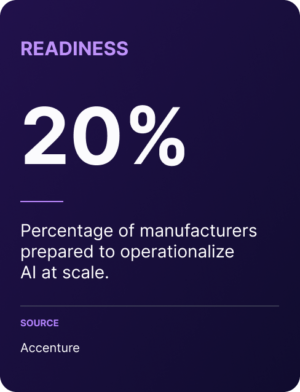
Nearly every manufacturer is actively evaluating AI. Only 20% consider themselves ready to deploy it, according to Redwood Software's Manufacturing AI and Automation Outlook 2026.
Evaluating AI means researching tools, attending demos, and running conversations with vendors.
Being ready means having the data infrastructure, systems integration, control environment, governance structures, and workforce capability in place to sustain what AI requires on the floor.
Most organizations are deep into the first.
Few have built the second.
For many teams, the challenge is not resistance or lack of interest. It is not knowing where the foundation gaps are before committing to a direction.
Where Industrial AI Initiatives Stall
Organizations that move too quickly often follow the same pattern.
A pilot launches on a single line. The results look promising in that controlled setting. Then the team tries to scale it up, but the environment does not support it.
Data historian tags are inconsistent. MES outputs require manual reconciliation before they can enable decision‑making.
Control systems run firmware vendors that no longer support. IT and OT operate as separate environments with different priorities and governance.
The pilot stalls.
It wasn’t because the AI model failed.
It happened because the environment where it was launched was never prepared to support it.
Manufacturing teams have seen this before. A test runs well in isolation and stalls when extended. With AI, the consequences go deeper. What stalls is not just a project. It is the organization's ability to move forward at all.
Where Most of the Budget Doesn't Go
The largest driver of AI success also quietly receives the least attention.
In manufacturing, human capital ranks as the lowest-maturity category within smart manufacturing initiatives. Which means organizations are spending the least time building the group that has the most impact on whether AI works.
Only 1 in 5 companies has established a mature governance model for autonomous AI agents. More than a third of manufacturing executives identify workforce adaptation as their top concern.
The 70% in the 10/20/70 formula is not soft infrastructure. It is the operating foundation that determines whether AI initiatives scale, sustain, and deliver value.
And it lands on the people who have to make AI work on the floor.
What This Means in Practice
- Someone owns data quality and is accountable for it.
- Success criteria are defined before an initiative launches, not after it stalls.
- IT and OT operate within shared security standards and planning cycles.
- Operators understand what AI recommendations mean and trust them enough to act.
- Plant leadership and executive leadership are aligned on what deployment requires, not just what it promises.
Manufacturers that create measurable value know where to direct the effort. It starts with the 90%, not the model.
They deploy AI systems across multiple functions. They invest in data quality, governance, workforce readiness, and workflow redesign before expecting AI to transform performance.
They also choose use cases that change how work gets done, instead of just automating isolated tasks.
They did not get there by starting with the AI model
The Question That Changes the Outcome
“When do we do AI?”
That is what your CEO is asking. It is a question your plant floor can't answer – yet.
That doesn’t mean it’s the wrong question, just not the question that gets you to value.
The question that changes the outcome in your favor is different: “What has to be true before AI can create value here?”
The first question assumes technology is the constraint. The second examines the operation and asks whether it can support and sustain the proposal. And what might need to be different to be successful.
Steve Orth, VP of Engineering at EOSYS, has seen what happens when manufacturers skip that question.
"People who think they can just apply AI as a hammer and solve all their problems are starting in the wrong place. They've first got to get their data in order. That's where an integrator can help. Then they can go use AI to solve the hard problems.
– Steve Orth
Knowing how to implement AI in a manufacturing facility starts with a diagnostic, not a decision about which AI platform to buy first.
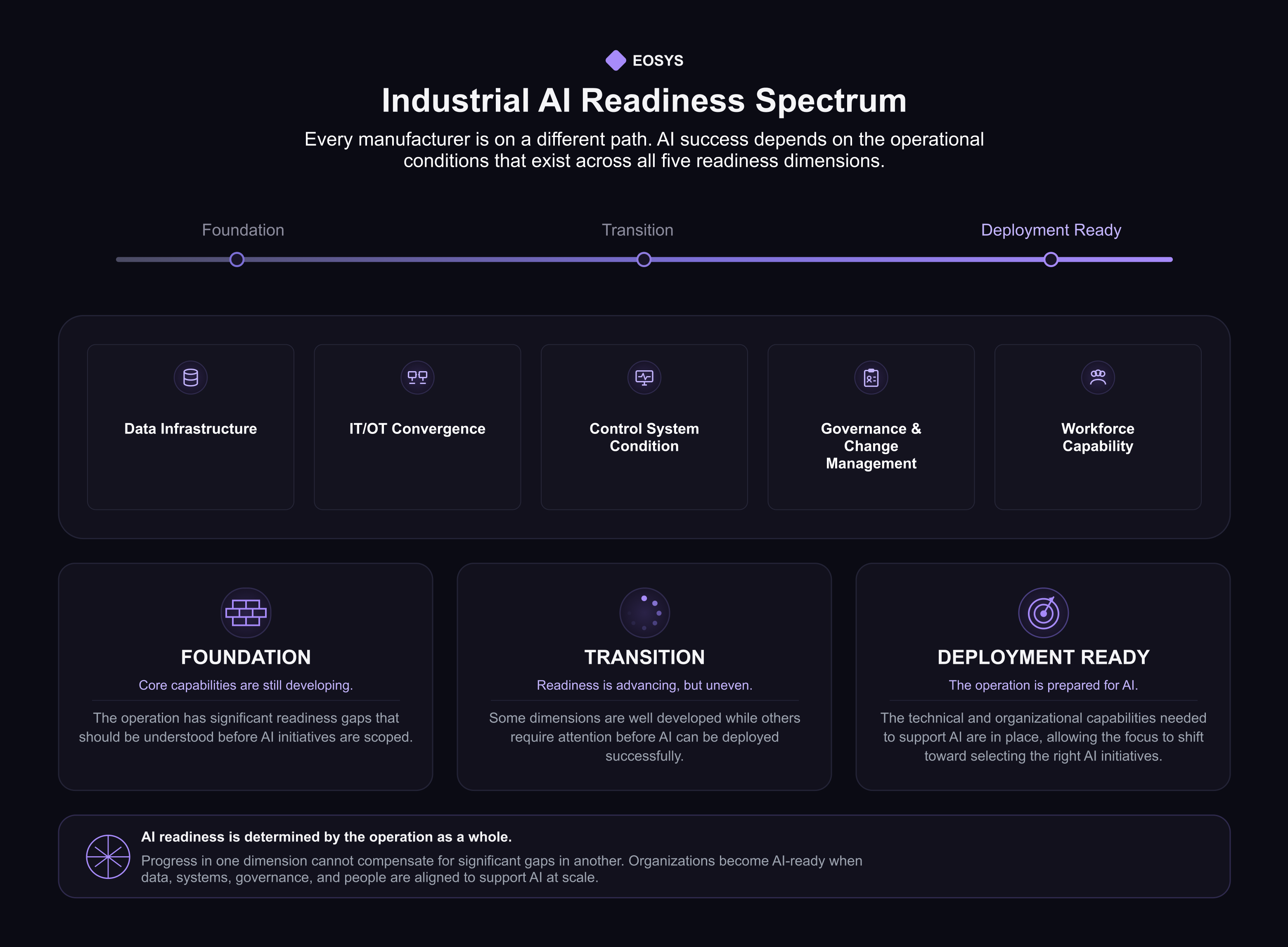
That diagnostic looks across five dimensions of operational readiness. It is the same framework experienced integration partners use to evaluate where an operation stands before any initiative is scoped.
Dimension 1: Data Infrastructure
Manual extraction before data becomes usable is one of the most common readiness challenges in manufacturing.
In Food and Beverage and CPG environments, inconsistent tag structures across production lines are common enough to go unnoticed. They become visible the moment an AI model attempts to learn from the data.
Data infrastructure is a prerequisite for AI, not an optional upgrade. When it is working, OT data is accessible without manual extraction, consistently tagged, and owned by someone accountable for its quality.
Dimension 2: IT/OT Convergence
Many manufacturers connect operational facilities and enterprise environments through workarounds rather than a designed architecture.
That approach works until data must move reliably and securely between the plant floor and the rest of the business. AI depends on that flow to be successful
IT and OT convergence is a precondition for AI success, not a parallel initiative.
Dimension 3: Control System Condition
End‑of‑life control systems remain common across automotive, chemical, and metals operations.
Every new integration requirement introduces additional risk to hardware that was not designed to carry it. When an unsupported system fails, recovery time is often determined by parts availability instead of response speed.
Control system modernization is part of AI readiness, not a separate capital project. Hardware that can’t support additional integration cannot support AI, regardless of what the model can do.
Dimension 4: Governance and Change Management
Many organizations lack a defined owner responsible or the governance for scaling, stopping, or adjusting an AI initiative once it starts.
Success criteria have not been defined. Escalation paths do not exist. No process governs conflicts between system recommendations and operator decisions.
Technology deployment accelerates while organizational readiness remains unchanged.
Dimension 5: Workforce Capability
Operators may understand the technology and still not trust it enough to act on its recommendations.
That hesitation is where many initiatives stall.
In process industries such as chemicals and pulp and paper, operator judgment carries direct safety and production consequences. Trust must be built before deployment. Starting that work before deployment is what makes the difference.
Every Sector Has AI Readiness Challenges
The challenges vary by sector, but the core problem is the same: AI only works when the underlying conditions and infrastructure are in place to support it.
 | Food & BeverageBatch and continuous‑process operations managing high SKU counts, frequent changeovers, and food‑safety traceability face data infrastructure challenges that must be addressed before AI can deliver value. Historian data that is inconsistent across product lines cannot reliably support integrated AI models. |
 | Consumer Packaged GoodsSeasonal demand patterns, retailer variability, and supply‑chain complexity create pressure to move quickly. Organizations that accelerate AI initiatives without addressing underlying data and IT/OT challenges often see the same outcome: test runs that succeed on a single line but fail to scale, or stall in place. |
 | AutomotiveLegacy control systems, multi‑plant data environments, and safety‑critical processes make control system condition and governance among the highest‑priority readiness dimensions in the sector. |
 | Chemical and Process IndustriesContinuous‑process operations with complex interdependencies require levels of operator trust and workforce readiness that many AI deployment plans underestimate. |
 | MetalsAging infrastructure, demanding operating environments, and limited tolerance for unplanned downtime make control system condition a critical readiness factor. |
 | Spirits and Pulp & PaperLong production cycles, regulatory traceability requirements, and small IT organizations often create IT/OT convergence challenges that are widely understood but remain unresolved. |
The ROI on Readiness Starts Before AI Deploys
Digital transformation delivers before AI arrives. Accessible OT data compresses decision cycles. Connected systems free engineering teams from manual reconciliation.
Consistent data structures surface quality issues before they reach the customer. None of that requires a machine learning model.
When OT data becomes accessible without manual extraction, decision cycles that once took days now take hours.
When historians, SCADA, and MES systems no longer require manual reconciliation, engineering teams spend less time managing data and more time acting on it.
When production data is tagged consistently, and someone is accountable for its quality, downtime events surface earlier, and quality deviations appear before they reach the customer.
These returns do not require a machine-learning model.
They require the infrastructure that a machine-learning model depends on. That infrastructure is Digital Transformation.
Companies that build the foundation before committing to AI arrive at deployment with infrastructure built to sustain it.
Systems integration and data quality come first. Governance structures and workforce preparation move alongside that technical work, not after it.
Resource: E-Guide | Am I Ready
What the High Performers Do Differently
Operations leaders making measurable progress share one behavior. Before committing to a direction, they evaluate the operation as it exists today, not as the architecture diagram suggests.
They find out what the infrastructure, people, and processes can realistically support. Then they use that picture to determine where the work begins.
That work is not linear. Data infrastructure, governance structures, and workforce preparation overlap and develop concurrently.
Different dimensions move at different speeds depending on where each one starts.
The only fixed point is that the AI model comes last. Everything else runs concurrently.
Know Where Your Operation Stands
Many operations leaders already suspect something on the factory floor may not be ready for AI.
What they often lack is an accurate picture of where the challenges exist and which ones to address first.
Asking whether your operation is ready is the right starting point. The next step is to understand where it stands across each of the five dimensions that determine what "ready" looks like for you.
An AI readiness assessment guides you through each of the five dimensions independently, built for the people closest to the work: controls engineers, IT leaders, and operations directors.
And when multiple people from the same operation take it, the differences in their scores often reveal as much as the scores themselves.
Take the assessment and see where your operation stands.
Manufacturing AI Readiness: A Strategic FAQ for Operations Leaders
The technical foundation comes first: standardize the data model, connect systems, and stabilize the control infrastructure. Governance and workforce preparation run concurrently with that work, not after it. AI deployment follows once the infrastructure required to support it is in place.
Organizations that skip the foundation often see the same result: a test run succeeds on a single line and stalls when the team tries to extend it. The model was not the problem. The environment was not ready to support it.
Successful implementation begins with a readiness assessment across five dimensions: data infrastructure, IT/OT convergence, control system condition, governance and change management, and workforce capability.
Each dimension is evaluated independently. The lowest-scoring dimension typically determines the pace of progress, and should be addressed before committing to an AI deployment timeline.
A rollout strategy should address both the technical and organizational conditions required for deployment.
That includes structured data, IT/OT convergence, control systems capable of handling additional integrations, a governance model that defines ownership, and a workforce prepared to act on AI recommendations.
Boston Consultings's research found that 70% of AI success depends on people, processes, and organizational readiness. A strategy focused primarily on technology is unlikely to succeed.
The five dimensions are data infrastructure, IT/OT convergence, control system condition, governance and change management, and workforce capability.
Most operations score unevenly across all five. The dimension presenting the greatest constraint usually determines where the work must begin.
Boston Consulting's research points to a sequencing problem.
AI models account for only 10% of what determines success, yet many organizations invest there first. The larger challenge lies in data, governance, workforce readiness, and operational alignment.
When those conditions are not in place, promising pilots struggle to produce measurable outcomes at scale.
Yes. When OT data becomes accessible without manual extraction, decision cycles accelerate. When historians, SCADA, and MES systems no longer require manual reconciliation, engineering teams can concentrate on action. Consistent data structures and ownership also make it easier to identify downtime events and quality issues before they become larger operational problems.
These benefits do not require AI. They come from building the infrastructure AI depends on.
The timeline depends on an operation's maturity across the five readiness dimensions.
A significant gap in data infrastructure or control systems typically requires more effort than a smaller gap in workforce capability or governance. The assessment helps identify which dimension is setting the pace and what a practical roadmap looks like from that starting point.
Many organizations do not have a clear answer.
Responsibility is often distributed across IT, business functions, and operations, leaving no defined owner when issues arise.
Establishing governance before deployment creates a documented decision-making framework, assigns accountability, and provides a structured path for expanding AI responsibly.