August 19, 2026
Smarter Together: The Role of AI in System Integration
Available technology isn't the same as being ready to deploy it. Here's what closes that distance.
AI adds an intelligence layer to traditional system integration, allowing connected equipment to predict, learn, and optimize processes in real time. The technology is ready.
Is your plant?
Artificial intelligence is changing the factory floor, and manufacturing leaders know it. But many manufacturers are moving faster than their operations can support.
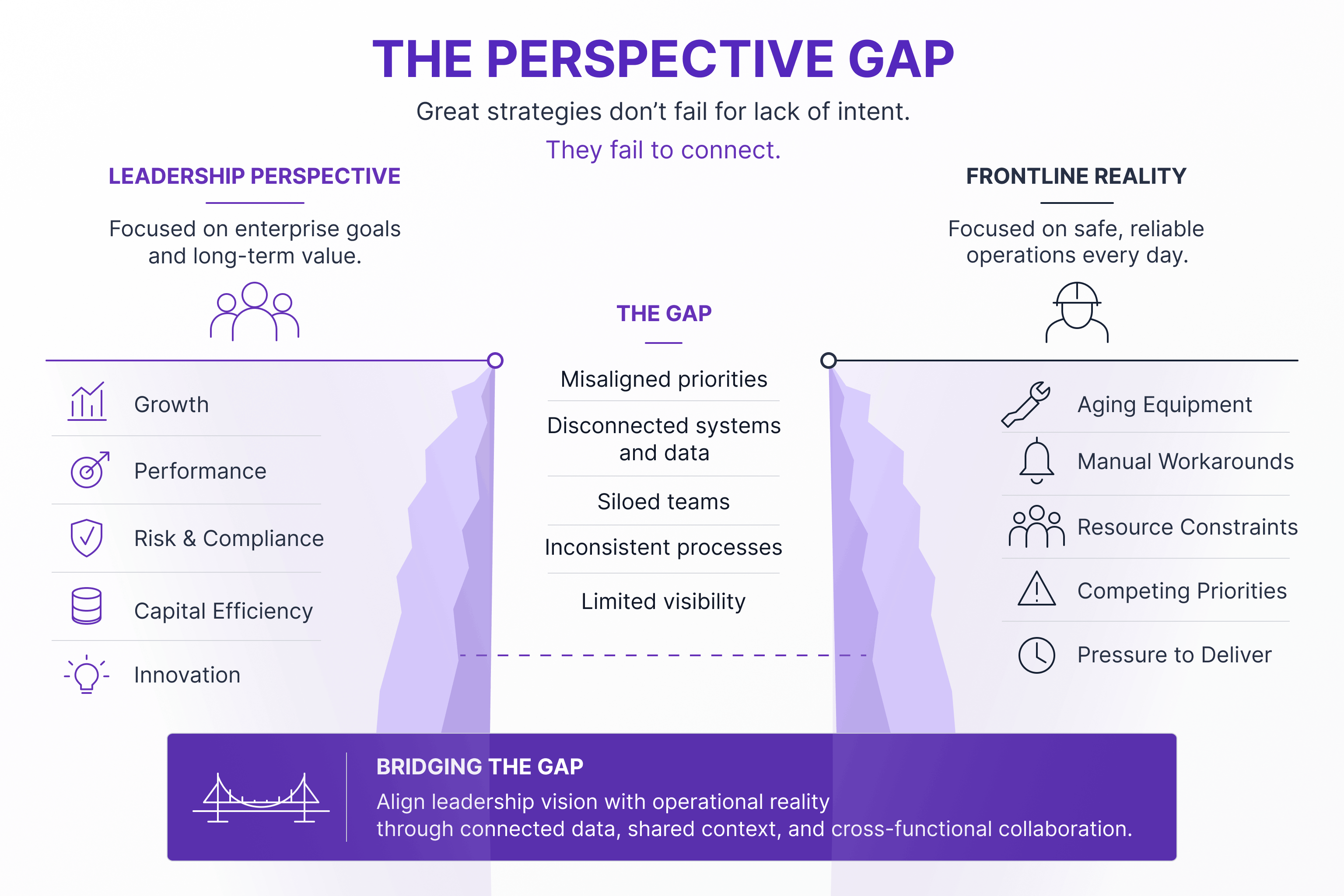
Having the technology available isn't the same as being ready to deploy it. That's the perspective gap: what leadership expects AI to deliver, measured against what the plant floor can actually support.
Before asking what AI can do, ask the harder question: “Am I Ready for AI?”
The Convergence of AI and Industrial Automation
Automation has long allowed manufacturers to run more efficient, reliable processes. It can reduce the risk of process failures, increase production speeds, and maintain more steady output quality.
Historically, industrial automation relied greatly on three core technologies: programmable logic controllers (PLCs), distributed control systems (DCS), and supervisory control and data acquisition (SCADA) systems.
In practice, PLCs and DCS managed real-time control processes, while SCADA systems collected and displayed operational data that teams could use to monitor performance.
Industry 4.0 adds another layer to this architecture: Intelligence.
This is where AI fits. By combining machine-learning models with connected sensors and software, AI enables systems to learn from operational data, recognize patterns, predict outcomes, and optimize processes in real time.
What changes with AI isn’t automation itself. It's what automation can now see, predict, and adjust on its own.
The Role of System Integrators in the AI-Driven Factory
AI still can't think its way through a problem it wasn't trained to handle.
It works within the scope of the data, goals, and operating conditions it was designed for. People can interpret broader context and adapt when something falls outside that scope.
As a result, AI can’t simply be bolted onto existing processes. It must be purposefully integrated into automation architectures, including edge computing networks, cloud environments, and PLC-based control systems.
System integrators connect components such as data pipelines, machine-learning models, and real-time control systems to production processes at scale. That work allows hardware, software, sensors, and controls to exchange data reliably, giving teams greater visibility and flexibility throughout production.
Once connected to the right data and controls, AI can add value over several core plant-floor functions.
Where AI Adds Value on the Plant FloorPredictive maintenance. AI-powered condition monitoring flags potential failure points, such as vibration or temperature spikes, before they cause downtime. Process optimization. AI algorithms fine-tune process parameters in real time to raise yield, throughput, or energy efficiency. Quality assurance. Computer vision systems identify defects and patterns that rule-based systems may miss, particularly when variations or interactions are difficult to encode as fixed rules. Robotics and autonomous operations. AI enables robotic arms, automated guided vehicles (AGVs), and cobots to adjust their paths and behavior as production conditions change. Data analytics and decision support. Connecting data from MES and SCADA systems, sensors, and historical records to AI models turns raw production data into predictive insight. |
What Industrial AI Readiness Requires
System integration defines how AI connects to automation. It doesn't answer whether an organization is ready to make that connection work.
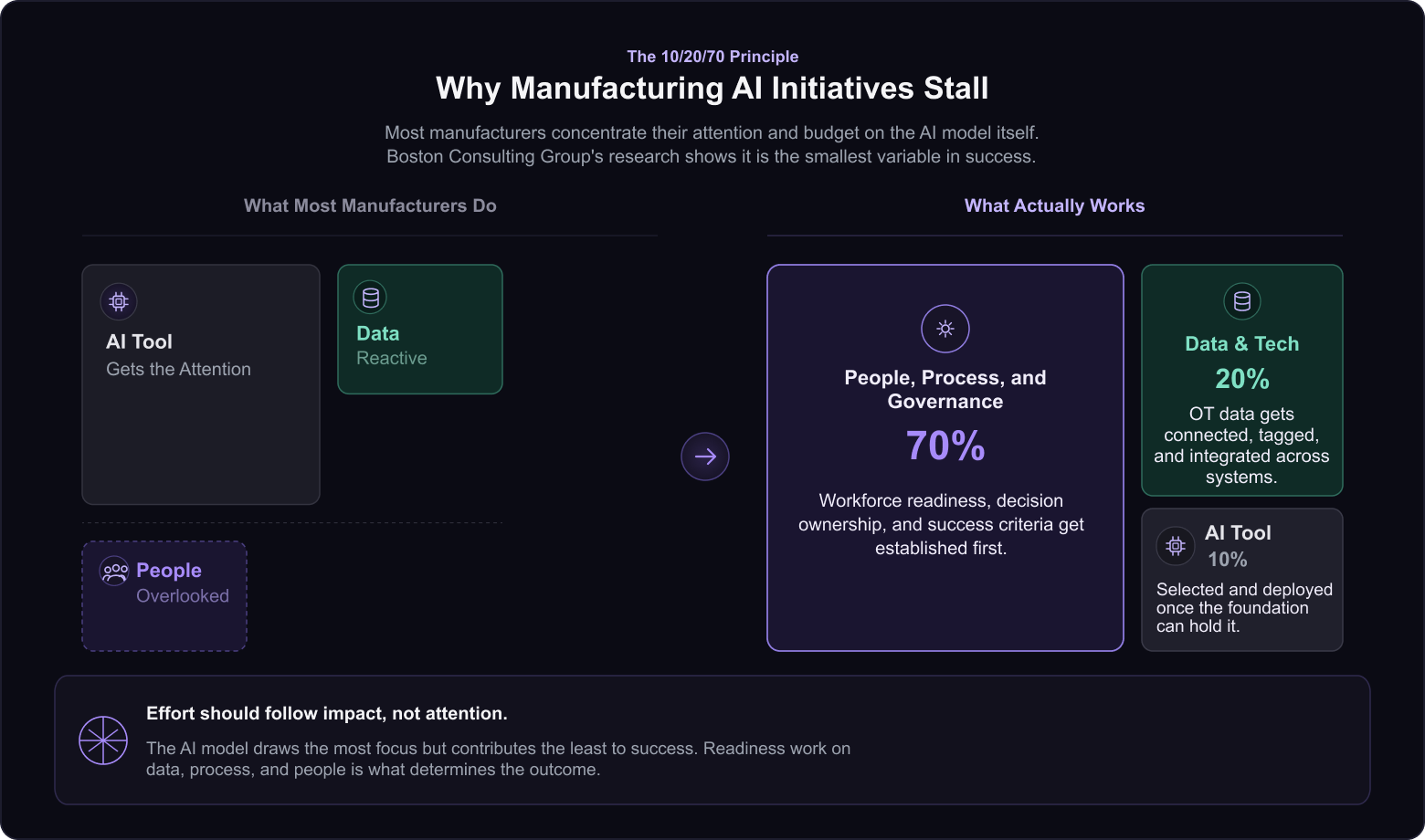
Most of the work isn't in the AI model itself. It's in the data, systems, governance, and people underneath it. Until those foundations are ready, an integrated AI tool may perform well in a pilot but fail to hold up in production. Building those foundations takes more than a new tool. It requires a clear view of what needs to change first and in what order.
Overcoming Barriers to AI Integration in Automation
Moving from a viable AI use case to a dependable production system requires overcoming five common barriers.
Where Pilot to Production Breaks DownLegacy infrastructure: Many manufacturers still rely on legacy PLCs, siloed databases, and SCADA systems that weren’t designed to exchange data with modern sensors, edge devices, or cloud platforms. Bridging those environments requires system integration expertise. Data shortfalls: Effective AI depends on timely, accurate, and contextualized data. At best, poor data creates a delay between operating conditions and AI recommendations. At worst, it leads to decisions based on incomplete or inaccurate information, increasing the risk of downtime. Cybersecurity: Connecting operational systems, edge devices, and cloud platforms expands the attack surface. Secure, consistent data flow between edge and cloud systems isn't optional when AI informs decisions on the plant floor. Change management: The best AI framework won't deliver value if operators don't trust its recommendations. Training needs to happen before new systems go live, giving frontline staff time to understand the outputs and build trust in a controlled setting. Scalability: A pilot proves an idea works on one line. It doesn't prove the same process will hold up across multiple lines or sites. Projects built without plant-wide deployment in mind tend to stall at the point they're supposed to scale. |
Implementing AI in Industrial Automation
Overcoming these barriers requires discipline at every stage of implementation. The six practices below provide a practical path toward reliable, scalable AI operations grounded in how the plant actually runs.
6 Best Practices That Help Streamline Industrial AI Integration

|
1. Start Small, Scale StrategicallyStart with a targeted use case, then scale once its value and repeatability have been proven. For example, a manufacturer might start by optimizing energy use on one production line or applying predictive maintenance to a specific machine or group of similar assets. A contained deployment lets the team identify savings, address integration challenges, and establish a repeatable model before expanding. A system integrator like EOSYS can identify the right starting point and define measurable goals for the initial deployment. |
|
2. Integrate at the Control LevelAI insights can only go so far if they never reach the controls that govern production. For AI to affect plant-floor operations, it must connect with PLCs, SCADA systems, and other control infrastructure through defined, governed workflows. Depending on the risk involved, the system might recommend an action for an operator to approve or automatically trigger a pre-approved control response. |
|
3. Pair Edge and Cloud ArchitecturesCloud platforms provide scalable computing resources for long-term data storage, machine-learning model training, and application development. What the cloud can’t always provide is the low-latency response required for real-time production decisions. Data captured from IoT sensors and PLCs may require immediate action. If embedded sensors detect a sudden pressure change, for example, the plant can’t wait for the data to travel to the cloud, be processed, and return before responding. Edge computing places processing closer to the equipment so time-sensitive decisions can be made locally. The right architecture uses the edge for immediate operational responses and the cloud for data-intensive work over longer timeframes. |
|
4. Maintain a Human-in-the-Loop ApproachAI can recognize patterns at speed, but it doesn’t replace human judgment. Human oversight is particularly important when an AI output could affect safety, quality, or regulatory compliance. Operators need a defined way to validate recommendations, intervene when conditions fall outside the model’s scope, and document the final decision. Accountability doesn’t disappear because AI was involved. Manufacturers still need to establish who has the authority to act when the system and the operator disagree. |
|
5. Build a Scalable Data FoundationData pipelines must move information among PLCs, MES platforms, and cloud environments without requiring manual rework at every handoff. Standards and protocols such as OPC UA and MQTT provide a consistent way for disparate systems to exchange information, even when they weren't originally designed to communicate with one another. Skip this step, and every new AI use case will end up rebuilding connections the previous deployment already solved. |
|
6. Prioritize Explainability and Secure IntegrationAI models are often described as a black box. Teams may be able to see the inputs and outputs without understanding why the model produced a particular result. The lack of visibility makes validation, troubleshooting, and accountability more difficult. Manufacturers should document data sources, model versions, permissions, decision thresholds, and the conditions under which human review is required. Explainability must be paired with security at every connection between AI and operational technology. Access should be restricted, data should be protected in transit, and AI-to-OT communication should be monitored throughout the deployment. |
Where the Perspective Gap Actually Lives
Those six practices assume the organization behind them is aligned. Often, it isn't. The same tension that opened this piece, leadership pushing forward while the plant floor absorbs the risk, shows up again here, and it's usually the real reason a technically sound plan stalls.
The practices above assume a plant is ready to act on them. Whether it is comes down to five areas.
|
Together, these five areas show where the distance between leadership expectations and plant-floor reality is greatest.
From Control Systems to Intelligent Operations
Manufacturers don't need to wait for AI technology to become viable. But moving forward without a clear plan can leave them with more complexity, cost, and risk.
The difference between an AI strategy on paper and one that runs on the plant floor comes down to one thing: whether it's connected to the data, controls, and workflows already in place, and whether the operation behind it is ready to support that connection.
The technology is ready. The next step is finding out if your operation is.
Questions Worth Answering Before You Deploy AI on the Plant Floor
Most automation systems can support some form of AI, but capability isn't the same as readiness. Legacy PLCs, siloed databases, and SCADA systems that weren’t designed to exchange data with modern AI platforms often require initial integration work.
An assessment of data access, connectivity, processing capacity, and cybersecurity can determine whether an integration layer is enough or a broader system upgrade is necessary.
Capability describes whether the technology can perform the intended task. Readiness describes whether the plant’s data, systems, governance, and people can keep it working reliably in production.
A plant can have access to advanced AI tools and still not be ready to deploy them responsibly.
AI must be integrated into the existing automation architecture, including edge computing networks, cloud environments, and PLC-based control systems.
Without the right connections, AI can’t reliably access operational data or turn its outputs into governed actions. It remains a separate tool rather than becoming part of the production process.
A pilot proves a use case under limited conditions. Scaling introduces more equipment, data sources, control systems, users, and security requirements.
If the pilot depends on custom connections or manual work that can’t be repeated throughout the plant, the deployment is likely to stall when expansion begins.
The five dimensions are data infrastructure, IT/OT convergence, control system condition, governance and change management, and workforce capability.
No plant needs to score highly across all five before it can begin. The assessment should reveal which gaps must be tackled before deployment and which can be managed as the scope expands. That knowledge enables teams to set more realistic budgets, timelines, and starting points.
Not every AI deployment requires an external system integrator. A manufacturer may be able to manage the work internally if it has the necessary OT, IT, data, cybersecurity, and change-management expertise and capacity.
A system integrator becomes valuable when those capabilities are fragmented, internal teams lack capacity, or the AI deployment must connect with multiple legacy systems.
The decision should be based on the plant’s readiness gaps and the risks involved, not just whether the organization can access an AI tool.